Every part of us has a place on the brain's surface, and practice makes that place grow.
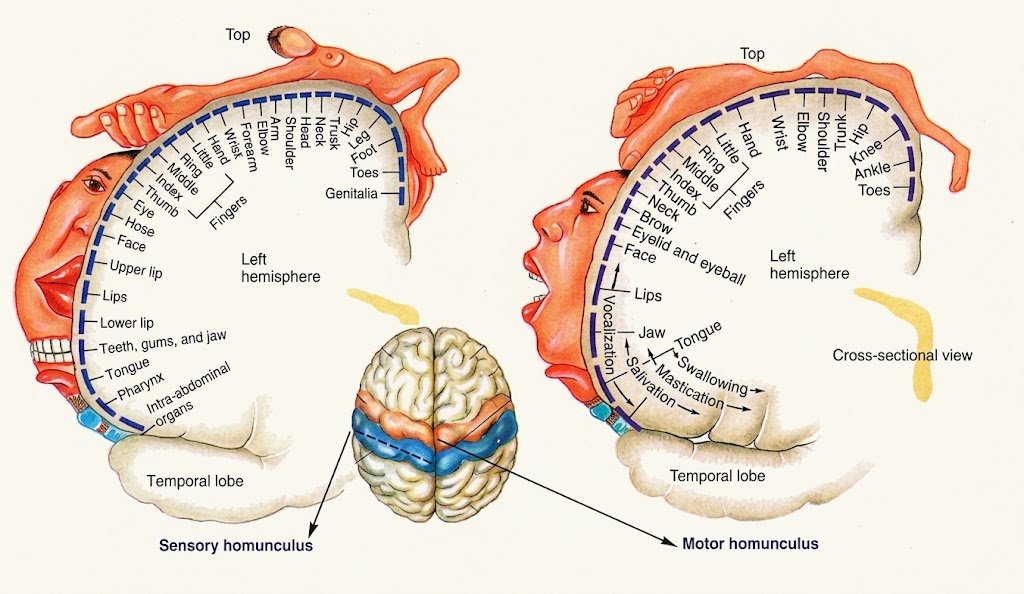
Across the top of the brain run two narrow strips. One feels touch, the other moves the body, and each holds a full map of us from toes to tongue. Drawn to the size of its share of that map, the body becomes this strange little figure: the homunculus.
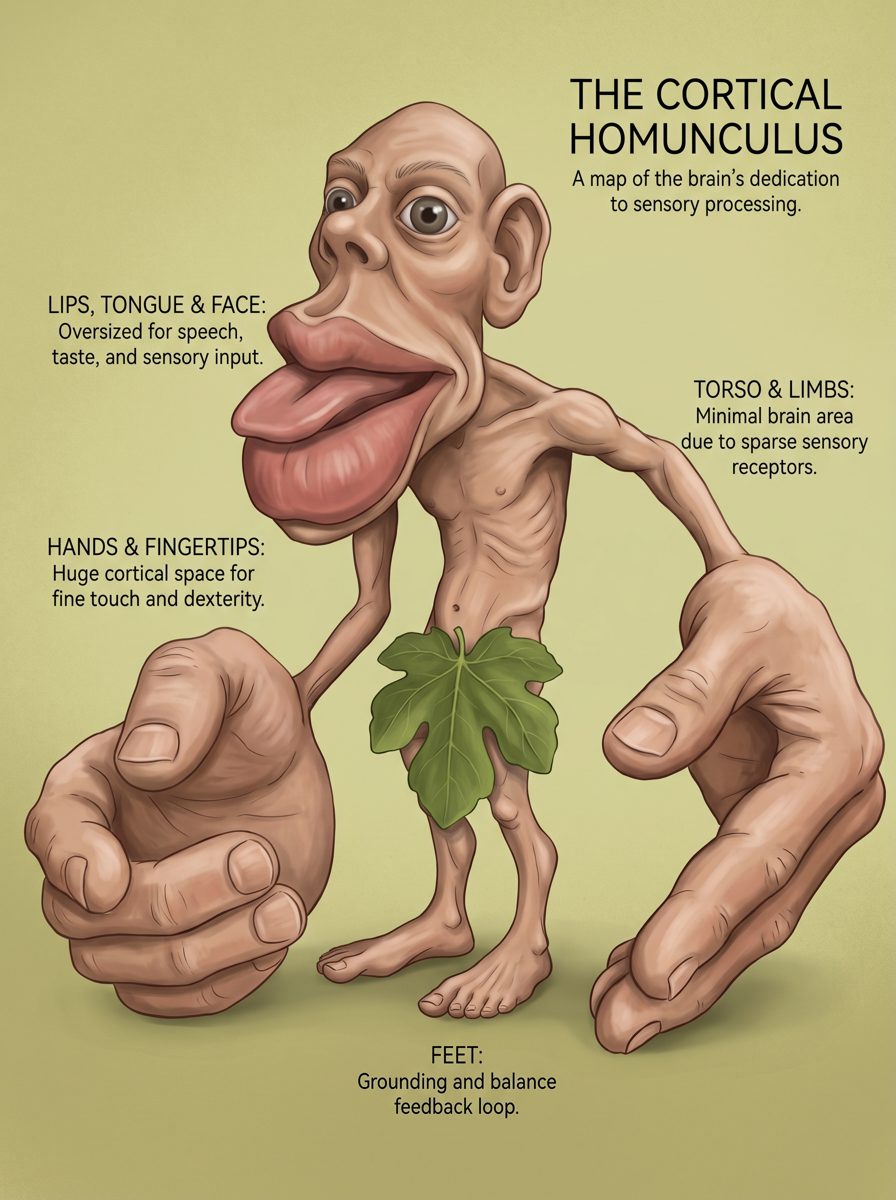
Our hands get a huge stretch of brain, because they are packed with touch sensors and make the finest movements we have.
Speech, taste, swallowing and expression need fine control and fine feeling, so the mouth and face take the biggest part of both maps.
Our trunk, arms and legs have far fewer touch sensors, so the brain gives them very little room. We feel them only roughly.
The soles report every shift of weight. On the map the feet and toes sit at the very top of the strip, right beside the genitals.
The map is not fixed. Parts we use with attention take up more room; parts we neglect shrink back.
The two strips run from ear to ear across the top of the head, just in front of and behind the central groove of the brain. The sensory strip (blue) feels; the motor strip (orange) moves. Neurosurgeon Wilder Penfield traced both maps in the 1930s and 1940s by gently stimulating the brain surface in awake patients and asking what they felt.
In Trailing Clouds the hand turns in the direction it moves. Feeling the palm and the trail behind it engages one of the largest areas of the map.
Slow, repeated movement felt from the inside is the same recipe that grows the map in musicians and braille readers.
The seals hold attention on centers the brain barely maps. Each hold brightens a faint part of us.
What we notice today becomes part of where we begin tomorrow. The map remembers the practice.
The homunculus shows how the brain sees us now. Practice changes the drawing. See how the seven centers rest on the wider nervous system in Our Greater Brain.